Drapers Rules
Drapers
Merchants of the old world
Game Rules
You are a playing a novice draper (cloth merchant), just beginning his business in the dangerous waters of the trade world. Cloth trade is the new and hot thing around the Mediterranean these days. But there are others who begin their journey as well, all vying to become the world’s most renowned draper, willing to do whatever it takes to get to the top.
Now, producing high quality clothing is not an easy task you know, even in this modern age. You need to grow sheep and shear their wool. Then turn it into raw cloth. In addition one needs to grow plants to generate the dyes to color the cloth, treat the cloth (in urine of all things, thanks god for serfs) and dye it before it can be sold. This is just the beginning… you then need to ship it, beware of pirates and hopefully get a good sum at the end of the line.
But you are not one to shy away from hardship. You are determined to become the greatest merchant the world knew. Good luck.
In this game you will be competing against up to 7 other players, each positioned in one of the great old merchant cities of the Mediterranean sea.
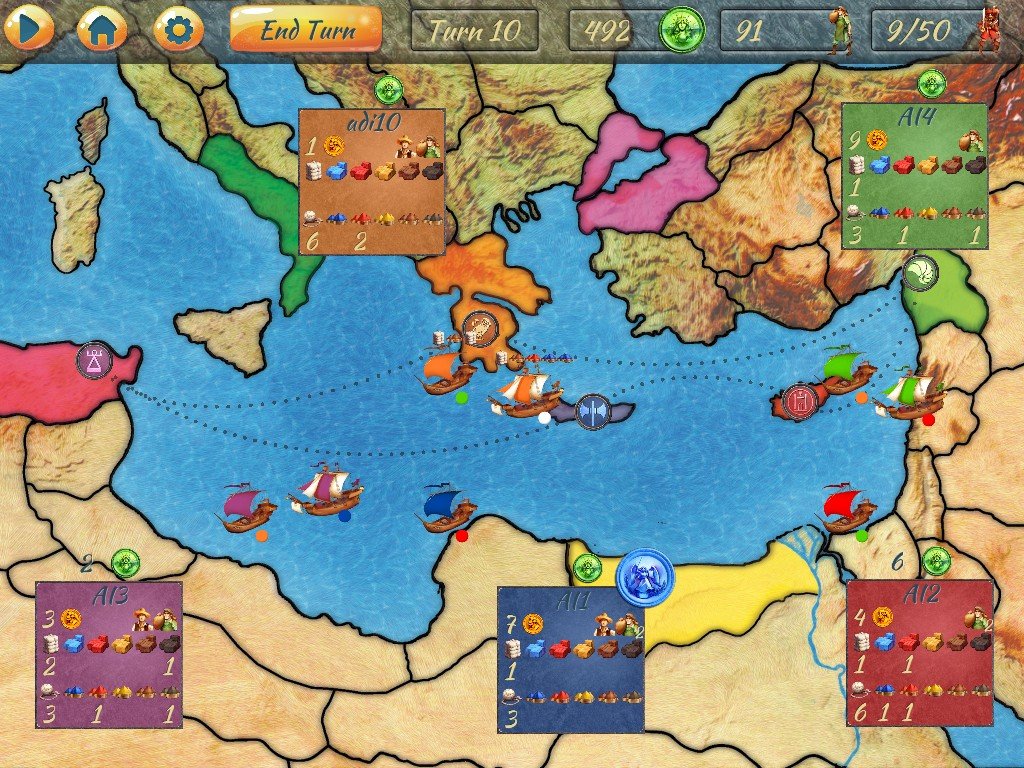
The game plays in turns where in each turn players perform their actions, mostly simultaneously, so a typical turn last only a minute or less. You begin with a bid action on new workers. You bid on who picks first from the selection of serfs and tenant farmers to recruit to your business. Bidding is followed by the build phase where most of the stuff happens. You can build one new facility or land each turn, position your workers, load cargo to ships and set their destination. If you have the pirate, this is a good time to place it on one of your opponent’s ships and watch his/her reaction.. Then there is trade, production takes place and we’re done.
Typical Turn Order
Bid Serfs -> Build ->Pirate-> Ship & Trade ->Limits check-> Produce
Game Components
- 1 First Player Token
- 1 Pirate Token
- 1 worker pool bag
- 16 ship route bars (5 long and 5 short)
- 8 Players Board
- 8 Players Tokens (for VP count)
- 24 Ship Cards (8 with 2 slots on 1 side and 4 slots on the other side, 16 with 4 on one side and 6 on the other)
- 120 Land tiles – 40 Sheep Herd, 24 Woad (Blue), 16 Madder (Red), 16 Weld (Yellow), 16 Walnut (Brown) and 8 Iron (Black).
- 192 Building tiles – 24 buildings for each player, color coded.
- 80 Wool/cloth tokens – 10 per player
- 160 Dye tokens – 20 tokens per player – 6 Blue, 4 Red, 4 Yellow, 4 Brown and 2 Black.
- 248 Worker chits – (15 Green, 12 Brown and 4 Blue per player).
- 120 Gold chits – 80 1G and 40 5G (35 per player, for a total of 280G)
Total 980 items if you really want to know.
Game setup
Worker Pool
The worker pool is where each turn workers will be drawn and become available for bidding. For each player pick 3 Seaman (Blue), 11 Land workers (Brown) and 15 Facility workers (Green). Place all in the worker pool bag.
In addition, give one land worker and one seaman to each player as its initial working force.
Place all the gold in the center. This is the gold bank. From this bank, take 3 gold and hand to each player. This will be the player initial gold.
Place the players and the pirate tokens at the start of the VP counter at the top-right corner of the board game.
Place the pirate token besides the bank. This token will be used by players who wins the pirate during bids. The pirate goal is to steal 10 VP per player in the game. for example, 40 for a 4 players game and 80 for an 8 players game. He also steals the ships gold.
Player Pool
Each player set beside the player’s card:
- Land tiles listed on Appendix – Land List.
- Buildings tiles listed on the Appendix – Building list.
- Ships as detailed in Appendix – Ships Table.
- 10 Wool tokens
- All Player Dye color tokens – 6 Blue, 4 Red, 4 Yellow, 4 Brown and 2 Black.
This is the available pool of materials each player has at the beginning of the game. The player cannot own more than these numbers per each product, no matter his/her production capacity (Your production capacity is the amount of units you can produce each turn from each type of produce, such as wool, cloth etc).
Player Card
Each player picks a location on the map and gets its respective player’s card.
On the card place 3 gold from the bank, which will be your initial investment.
From the player pool of land tiles, take one sheep herding tile and place it on the board over one of the empty cells under the land section. Place the land worker you received from the bank on top of it. This constitutes the player initial production capacity for wool, which is 1 wool.
From the ship tiles, take the first ship as indicated in the appendix table “Ship’s Cargo Hold”, 1st column. Place it on one of the card empty ship cells. place the seaman you received from the bank on it. this constitutes the initial player trading capacity.
First Player Token
At the beginning of the game the ‘first player token’ is given randomly to one of the players.
After that, at the beginning of each turn the ‘first player token’ is moved to the next player clockwise. The token is used to determine the result in cases of draw during bids. The player with this token also get an additional gold piece at the beginning of the turn.
Turn start
In each turn there will be new surfs available. There are 3 types of workers in the game – seaman, land workers and building workers. Each is suited to work only in its respective area of expertise (ship, land or building). Their availability is determined by the number of players and the number of open slots at players boards for workers.
Check amount of open spaces on the player’s cards. From the bag randomly pull half that amount of people (round the result down) + number of players in the game. If the pirate is also available in this turn (See pirate section for details), place it at the line as well.
Worker Bid Phase
During this phase you will first need to bid on the order of selecting serfs from the line. each player takes the amount of gold he wishes to invest in this bidding. this amount is lost and will not return to the player no matter the result. Once everyone bid, the order is determined as follows:
- The player with the highest bid will be the first to select.
- The person next to select will be the one with the second-highest bid and so on.
- In case of a draw, the order of players is used to determine who selects first. starting from the player who owns the first player token and moving clockwise.
Once the selection order has been determined, the players now pick workers from the list according to this order. If there are more workers than players in the game, the cycle continues until all workers have been taken.
Once you have your workers, place them on your card accordingly. If you have no where to place a worker, you can place then at the card player pool.
Build Phase
In each turn you are allowed to build a single building, if you can afford it, or to acquire on plot of land. In additions, once you have ships and goods to sell, you can upload them to your ships and set their destination.
Land plots are used to herd sheep where you can shear their wool, and to grow plants from which you can extract the dyes.
Buildings are used to various purposes in the game, from dye extract factory to shearing shed and up to harbor. Each building provides a certain, unique benefit but has a cost as well. Building and Land only produce if they have workers on them.
Ships are used to howl your finished goods to the markets to be sold at the highest possible price. According to the number of players in the game, you are allowed to own up to 3 ships. See the tables at the appendix for details.
Setting ship destination – when your ship(s) has cargo you need to select one of the other players ports to set as the ship destination. This is done by setting the relevant ship dial to the desired port. The destination is hidden from the other players until all players submitted their ships. This is important as the more ships selling a good to a certain port, the lower this good price gets.
Shipping Costs – In addition, shipping may incur additional costs – each port your ship passes without unloading its cargo charges 1 gold as transition fees. So, for example, if your ship sails to your immediate neighboring port, you have no additional costs. However, if you choose to sail to a more remote port, then your ship travel will cost you the amount of ports you pass without stopping there. Before your trade begin, you need to pay the shipping cost to the bank. If you do not have enough gold, your ships will not sail.
Building is only half the story, in order to operate them, you will need workers. Sadly, experienced workers are hard to find and you will need to bid high to get the people you want working for you. otherwise, you may find your land growing weeds and you storage empty.
The Pirate
During the old ages, piracy flourished and merchants suffered great losses at time. However, the smart ones knew how to manipulate this to their advantage, paying pirates to take competitors shipments to take them out of business. In this game you have the option to play dirty.
The pirate appear once every few turns, determined by the number of players in the game. See appendix – Piracy Table for details. When the pirate appears, he is added to the workers pool and the player who gets to pick the pirate, can choose after the build phase which player’s ship to rob. All players know in advance when the pirate appears but not who will own it. calculate carefully or lose your precious VP and gold. The pirate must be used at the turn he appears or he is lost to the player.
Trade Phase
Trade is at the heart of Merchants. By shipping trade goods, you can accumulate VP and earn gold to progress your merchant empire. During the build phase you may have elected to load cargo to your ship(s) and selected a port destination for them, hoping to gain VP and top gold for your fine goods.
In this phase, for each harbor take all the ships arriving to this port and take their cargo out. For each product reaching this port:
If only a single player chose to ship it to this port, he has a monopoly. Each good shipped get its full value as shown at Appendix – Trade Table. Note that:
- Finished goods provide VP
- Raw materials provide Gold
- However, for every additional player who chose to ship the same good to this port (no matter how many units of this type were shipped), the value of that good drops by 1 at this port. This is true for both VP and Gold! The value cannot drop below 0.
Calculate the amount of VP each ship provided to its owner from finished goods and advance its player token on the game board. In addition, for each raw item shipped, add 1 gold to the ship.
Place the cargo back to the player bank.
If the player owning the port has an active Pier (occupied with a worker), he/she also gets 1 VP per ship docked during the turn.
If the pirate appeared in this turn, now is the time for the player who owns it to take that ship VP and gold triumphantly! Advance the pirate on the VP track and move back the player token. Return the gold to the bank. Once the pirate reaches its VP goal the game ends!
All the rest of the ships now return to their owners who can advance their VP position on the board and claim their prized gold.
Limit Check Phase
Worker Capacity check
Players can keep 1 un-assigned worker at the end of the turn, unless they own a populated Tavern or Lodge which increase these numbers. If players have more workers than allowed to keep than they need to remove workers up to their allowed limit. Remove workers in this order: first Seaman (Blue), then Farmers (Brown) and last Mill-Hand (Green).
Production Phase
Each player calculates its production capacity for each product in the following order:
- Finished goods for each dye (color). For each piece of finished goods, take one cloth token from your storage and put aside. then flip the dye token to its finished good side and place it at its finished goods location on your player card.
- Dyes – For each dye produced take one token of its respective color from the pool and place it at its destination on your player card.
- Cloth – for each cloth unit produced, take one wool token from your storage. Flip it and place at its cloth location on your player card.
- Wool – for each wool unit produced, take one wool token from the pool and place it at its respective location on your player card.
Turn End Phase
At this stage the turn is complete. If this is the last turn, check out each player gold to determine the winner. otherwise, hand over the ‘first player token’ to the next player and begin a new turn.
Game End
The game ends in case any of these conditions is met:
- When at the start of the turn, there are not enough workers to draw from the bag.
- When the pirate reach its VP target (10 VP per player).
- When there are no more VP chits in the VP Bank.
For each of the above scenarios, the game ends only after all players complete the turn.
Winner of the game
The one who have the most VP at the end of the game wins.
In case two or more of the players have equal amount of VP, the one with most Gold wins.
In case of yet another draw sum up the nominal value of each player produced goods at the end of the turn. The one whose value is highest wins.
2-Player Variant
Due to the interaction required in the game, for 2-players, there is one change. In addition to the two players locations, pick another two to serve as “target” ports. Players can ship and sell their cargo there as to any regular port, but a target port has no ships of its own and it does not take part in worker bids, production etc. All port pricing rules apply.
Appendix
Cloth Production, dependencies and few other things
In Merchants you are taking the role of cloth manufacturer and trader. You need to understand the process of manufacturing a finished cloth as the game leads you to mimic that process.
In this game we focus on producing cloth from sheep wool. While even in the old ages, people produced cloth from variety of raw materials, sheep was very dominant. In this case, you need to sheer sheep’s wool every season to begin the process. The raw wool need to be treated to turn it into yarn. I our game, this is only evident in some of the facilities which enhances wool production, but is not a required step in the game.
Instead, we assume that wool is ready to be turned into basic cloth material using looms. The game introduces several types of looms, from very basic ones used thousands of years ago up to some more modern ones (but still from hundreds of years ago, so don’t get excited).
In parallel, we need some dye to color the cloth to its finished color. In the old ages there were already quit e a few materials from which people used to extract the color to dye their clothes. However, some were more common and some were considered only for the rich and privileged. In our game we use the names of some of the more common flowers and trees used in the dye process, from the common Woad (blue) to the rich Weld (yellow). We also introduce brown extracted from the bark of walnut trees and black which is received from soaking cloth in baths full of iron ore.
Once you have the cloth and the dye to color it, you are ready to produce finished goods. These are the fine cloth rolls that are then shipped to their destination.
In Merchants we also allow to trade the raw materials and they provide much needed gold at the beginning of the game when each gold piece is important. Later, when you orient towards higher yields, you will need additional facilities to allow mass production of finished goods. Especially note the storage limitation posed which can be lifted using storage facilities.
There are many subtleties in producing fine cloth, some of them are mentioned in the game as facilities, such as the mordant bath which is used to soften the cloth using aluminum or similar component.
Production in the middle ages was labor intensive and often involved using slave work (serfs as they were called then). in Merchants, we attempt to illustrate this as well with the bidding process where you “pick” worker from a line to work in your fields or your factories.
Game Tables
Piracy Table
| Players Number | Pirate Appears |
|---|---|
| 2 | Every 4 turns |
| 3 | Every 3 turns |
| 4 | Every 3 turns |
| 5 | Every 3 turns |
| 6 | Every 2 turns |
| 7 | Every 2 turns |
| 8 | Every 2 turns |
Trade Table
Raw material provide gold, finished goods provide VPs.
| Raw Materials | Gold | Finished Goods | VP |
|---|---|---|---|
| Blue Dye(Woad) | 1 | Blue (Woad) | 1 |
| Red Dye (Madder) | 1 | Red (Madder) | 2 |
| Yellow Dye (Weld) | 1 | Yellow (Weld) | 3 |
| Brown Dye (Walnut) | 2 | Brown (Walnut) | 4 |
| Black Dye (Iron) | 2 | Black (Iron) | 5 |
| Wool | 1 | ||
| Cloth | 2 |
Ship’s Cargo Hold
| Players Number | Ship 1 | Ship 2 | Ship 3 |
|---|---|---|---|
| 2 | 3 Slots | 4 Slots | |
| 3 | 3 Slots | 5 Slots | |
| 4 | 3 Slots | 4 Slots | 4 Slots |
| 5 | 3 Slots | 4 Slots | 5 Slots |
| 6 | 3 Slots | 5 Slots | 5 Slots |
| 7 | 4 Slots | 4 Slots | 5 Slots |
| 8 | 4 Slots | 5 Slots | 5 Slots |
Land Tiles
| Plot of Land | Cost | # Per Player |
|---|---|---|
| Sheep Herding (Wool) | 1 | 5 |
| Woad Plantation (Blue Dye) | 1 | 3 |
| Madder Plantation (Red Dye) | 1 | 2 |
| Weld Plantation (Yellow Dye) | 2 | 2 |
| Walnut Plantation (Brown Dye) | 2 | 2 |
| Iron Plantation (Black Dye) | 2 | 1 |
Ship’s Cargo Hold
| Facility | Type | Bonus | Cost | Cost |
|---|---|---|---|---|
| Shearing Shed | Wool | +1 Wool Production if wool is produced | 1 Gold | 1 |
| Fulling Mill | Wool | +1 Wool Production if wool is produced | 2 Gold | 1 |
| Machine Shears | Wool | +1 Wool Production for each occupied sheep farm | 7 Gold | 1 |
| Back Strap Loom | Cloth | +1 Cloth Production | 1 Gold | 1 |
| Warp Weighted Loom | Cloth | +1 Cloth Production for each worker | 3 Gold | 1 |
| Power Loom | Cloth | +4 Cloth Production | 8 Gold | 1 |
| Walnut Extract Mill | Dye | 1 Walnut Produce per worker. Requires Walnut Plantation. | 4 Gold | 1 |
| Ironworks | Dye | 1 Iron Produce for each worker. Requires Iron Mine. | 5 Gold | 1 |
| Dye House | FG | 2 Finished Goods Produce for each worker | 1 Gold | 1 |
| Large Dye House | FG | 2 Finished Goods Produce for each worker | 4 Gold | 1 |
| Mordant Bath | FG | +1 Finished Goods Produce for each Dye House worker | 4 Gold | 1 |
| Deep Harbor | Trade | Reduce ship travel cost by 1 | 3 Gold | 1 |
| Pier | Trade | +1 VP for each incoming ship to your port. | 7 Gold | 1 |
| Tavern | Worker | Allow keeping up to 3 unassigned workers. | 3 Gold | 1 |
| Trade House | Worker | +1 VP for each ship with cargo sent to trade | 8 Gold | 1 |
| Guild Hall | Worker | +1 VP per finished good item on ship if it carries a single product type | 7 Gold | 1 |
Ship Tiles
| Small Merchant Ship | Trade | 3 Gold | * |
| Medium Merchant Ship | Trade | 4 Gold | * |
| Large Merchant Ship | Trade | 5 Gold | * |
* Amount depends on number of players. See ship cargo hold table for details.

Tiltan Games